
About the project
Connecting cultures, bridging realities
How can immersive technologies bring people, cultures and generations closer together?
As digital technologies transform the ways we communicate, interact and experience culture, new opportunities for connection are emerging. But these changes also raise important questions about cultural identity, inclusion, wellbeing and the future of human relationships.
LIL-ECHOES is a four-year European research project (2026–2030) exploring how extended reality (XR) and artificial intelligence (AI) are reshaping intercultural encounters and cultural experiences.
By bringing together 16 partners, among which are researchers, cultural organisations, technology developers and local communities, the project investigates how immersive technologies can support meaningful connections, encourage intercultural understanding and contribute to a more inclusive digital future.
At the heart of LIL-ECHOES are Living Cultural Labs, where migrants, senior citizens and young adults will help design, experience and evaluate new forms of intercultural interaction.
Our journey
Our journey begins with a simple question: How can we make virtual worlds more inclusive, culturally diverse and human-centred?
Follow our roadmap to discover how LIL-ECHOES is turning this challenge into opportunities for connection, creativity and intercultural exchange.
-
The challenge
Digital technologies are changing how we experience culture, communicate and build relationships. Virtual environments can connect people across geographical boundaries, offer new ways to share cultural heritage and create opportunities for intercultural exchange.
However, as cultural and social interactions increasingly move into digital spaces, important challenges emerge.
- Cultural identity and diversity. How do virtual environments influence the ways we express our identities, share traditions and experience cultural differences?
- Accessibility and inclusion. How can we ensure that people of different ages, cultural backgrounds, languages and levels of digital experience can participate meaningfully?
- Human connection and wellbeing. How do interactions in virtual worlds, including those supported by AI, influence our relationships, sense of belonging and wellbeing?
Our challenge is to understand how technology can strengthen human connections while respecting cultural diversity and individual experiences.
-
Our solution
Introducing the Living Cultural Labs
What if cultural spaces became gateways to new ways of connecting?
LIL-ECHOES will establish Living Cultural Labs (LiLs) in public cultural and community spaces across four countries: Germany, Greece, Italy and the United Kingdom.
These labs will bring together migrants, senior citizens, young adults and the general public to explore intercultural encounters through a combination of physical activities, extended reality and artificial intelligence. But participants will not simply experience new technologies. They will help shape them.
Through collaborative activities, community members will contribute their stories, memories, languages and cultural practices to the creation of immersive experiences.
The Living Cultural Labs will become spaces where people can:
- Connect: meet people from different cultural and generational backgrounds.
- Co-create: help design immersive experiences inspired by their own cultures and lived experiences.
- Explore: discover new perspectives through virtual environments and interactive activities.
- Reflect: question assumptions and develop a deeper understanding of cultural differences.
-
Our approach
How do we turn our vision into reality?
LIL-ECHOES combines interdisciplinary research, technological innovation and community participation. Our approach follows five interconnected steps, moving from understanding cultural interactions in virtual environments to developing practical solutions for communities, cultural organisations and policymakers.
Select a step to read more.
-
1 / Understand
Exploring culture and communication in virtual worlds
We investigate how people communicate, express cultural identities and build relationships in existing digital environments.
By studying virtual communities, we seek to understand how immersive technologies influence cultural practices, language use, social connections and wellbeing.
-
2 / Co-design
Creating immersive experiences together
Researchers, technology developers, cultural organisations and community members collaborate to design accessible and inclusive XR environments.
Participants contribute their experiences, stories and perspectives, helping ensure that the technologies reflect their cultural and linguistic diversity.
-
3 / Experience
Bringing intercultural encounters to life
The Living Cultural Labs will host immersive experiences combining virtual and mixed reality, AI-supported interactions and in-person cultural activities.
Participants will connect with others, explore cultural activities and engage with interactive stories.
-
4 / Evaluate
Understanding the impact on people and communities
We will follow participants over time to investigate how repeated immersive intercultural encounters influence communication, cultural understanding, wellbeing and belonging.
This research will help identify both the opportunities and challenges of increasingly virtualised cultural experiences.
-
The Living Cultural Labs
At the heart of LIL-ECHOES are three experimental immersive experiences. Each explores a different way of using XR and AI to bring people together, share cultural knowledge and encourage intercultural understanding.
Bridges in XR
Connecting beyond borders
Imagine meeting someone from another country in a shared virtual environment, exchanging perspectives and exploring cultural activities and experiences together.
Bridges in XR will connect local and remote participants through conversations, games and shared cultural activities. Immersive technologies, supported by AI-assisted dialogue, translation and reflection, will help people communicate across geographical and linguistic boundaries.
Living Culture 360
Discovering culture through immersive experiences
Imagine stepping into a cultural activity and experiencing it through the perspective of someone who practises it.
Community members will create immersive 360-degree videos showcasing cultural activities and everyday experiences. Other participants will explore these environments, interact with AI companions and engage in related hands-on activities.
Echoes in VR
Exploring stories, memories and perspectives
Imagine entering a story inspired by someone's memories and making choices that influence how it unfolds.
Participants will co-create immersive stories based on their cultural backgrounds and lived experiences. Through interactive virtual environments, others will explore these narratives, with AI supporting different story paths within boundaries established by their creators.
Our expected impact
LIL-ECHOES goes beyond the development of immersive technologies to explore how they can strengthen human connections, celebrate cultural diversity and contribute to more inclusive and connected communities. Through its research and Living Cultural Labs, the project aims to foster intercultural understanding, encouraging dialogue, empathy and meaningful exchanges between people from different backgrounds and generations.
By actively involving communities in the creation of immersive experiences, LIL-ECHOES also seeks to promote inclusive cultural participation, helping cultural organisations engage diverse audiences while exploring new ways to share, preserve and revitalise cultural heritage, languages and cultural activities.
At the same time, the project will contribute to responsible technological innovation by developing ethical, accessible and human-centred approaches to XR and AI. Its findings will also inform practical recommendations and European policies on digital innovation, cultural diversity and social inclusion, helping shape a digital future where technology brings people and cultures closer together.
Technical information
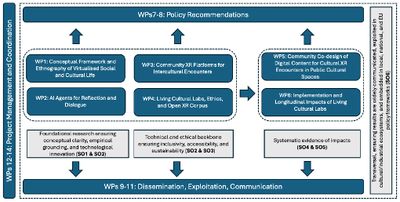
LIL-ECHOES runs for 48 months (September 2026 to August 2030) and is structured around 14 interconnected work packages (WPs).
Combining interdisciplinary research, technological innovation, community co-creation and policy engagement, the project follows an integrated approach from research and development to implementation, evaluation and dissemination.
The project record is on CORDIS, the European Commission's research results service.
Foundational research
Establishing the scientific foundations through research on virtual communities, intercultural communication and cultural identities, alongside the development of AI agents supporting dialogue and reflection.
Technology and infrastructure
Co-designing accessible XR platforms and establishing the technical, ethical and GDPR-compliant frameworks supporting the Living Cultural Labs and an open XR multimodal data corpus.
Community co-creation and implementation
Engaging communities in developing immersive cultural experiences and implementing Living Cultural Labs across four countries, while evaluating their long-term effects on intercultural understanding, wellbeing and social cohesion.
Policy recommendations
Translating research findings into practical recommendations and policy guidance for the ethical, inclusive and culturally sustainable development of XR and AI.
Communication, dissemination and exploitation
Sharing project activities and results, fostering synergies with other European initiatives and promoting the transferability and long-term impact of the Living Cultural Labs.
Management and coordination
Ensuring effective project governance, scientific coordination, ethical compliance and monitoring throughout implementation.
Specific objectives
SO1. Investigate how the virtualisation of social and cultural life transforms cultural identities, lived experiences, and multilingual practices of community members and for creative industries in immersive XR environments.
We will explore how individuals engage in meaning-making, cultural expression, and emotion and memory mobilisation within immersive XR environments, focusing on how cultural life is reconfigured in digital spaces across different cultural contexts. We will identify opportunities that XR and AI offer creators, in particular the possibility of reaching new audiences.
SO2. Co-design and test human-human and human-nonhuman (AI agents and cultural artefacts) interactions in XR environments as emerging forms of socialisation to support intercultural dialogue and cultural learning.
We will co-design and develop three experimental use cases (remote communication via XR and AI, AI-mediated interaction with community-created 360-degree experiences, and participatory cultural storytelling), and we will assess how XR technologies redefine the boundaries of social presence, interaction, and connectedness.
SO3. Develop inclusive, participatory co-creation measures that enable communities to shape XR social spaces reflecting diverse heritages and lived experiences within Europe's cultural and linguistic diversity.
By engaging communities in the co-creation of XR content and co-design of environments, we will establish new design methodologies for building socially meaningful, culturally situated, and safe virtual and blended experiences that support heritage, multilingualism, and participation.
SO4. Evaluate how immersive XR experiences, guided by AI reflection tools, foster users' capacity to reflect on cultural and linguistic diversity and engage meaningfully with differences.
Each use case will culminate in guided personal reflection facilitated by AI agents that prompt curiosity, empathy and criticality, enabling participants to confront and process cultural complexity, an essential skill for thriving in an increasingly virtual, diverse, and interconnected Europe.
SO5. Assess the long-term impacts of virtualising and blended intercultural encounters on interculturality and language use, social cohesion, wellbeing, sense of belonging, and renewal of cultural heritage.
We will collect and analyse empirical data on how repeated engagement with XR-based social and cultural interactions influences intercultural communication and language use, wellbeing, belonging, empathy, civic participation, and intergroup attitudes, contributing to a better understanding of the virtualisation of everyday social and cultural life.
SO6. Develop policy-oriented measures and design principles to support the ethical, inclusive, and culturally sustainable virtualisation of social life in Europe, including strategies to preserve and revitalise endangered cultural elements.
Drawing from our interdisciplinary research, we will communicate with the European industrial ecosystem and propose actionable frameworks for EU policy and innovation agendas that guide the development of virtual social spaces in line with European values of equity, diversity, and wellbeing.
Related projects
LIL-ECHOES is one of a number of European projects exploring immersive technology, culture and community. These are the projects we draw on and work alongside, including four that our own partners lead or contribute to.